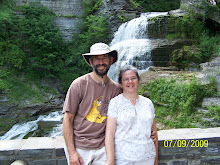
July 15, 2009
I74, Goal: the Mississippi River.
The state of Illinois is one huge field, 2/3 is corn and 1/3 is soybeans or something involving numbers in the millions of acres. It is not the custom to fallow any fields out here which seems very difficult for the soil which was compact in the field they recently turned from this practice.
There are many wonderful silos and farm machines and pieces of useful equipment. Also, windmills. It is really remarkably windy here. The wheels on the farm equipment are tremendous.
July 16, 2009
Albia Iowa
My favorite town we have been thru was Ipava . We’ve also been in Colcehster.
Tremendous farm machinery is all around us, sometimes folded in upon itself and carried on an equally tremendous orange truck that says “feeds and grains.”
We heard hoot owls calling back and forth around the lake and coyotes, a very large number of them, but all far away. Finally stars. The big dipper and the milky way and shooting stars. It was difficult to decide between small shooting stars and fireflys high above us. Fireflys (and mosquitoes and other wild life) were in abundance. The deep forest meadow where we camped (alone) was twinkling with fireflys.
We got very wet. Dew began to fall when we arrived and condensation continued lightly our entire night. The wood was very wet, thoroughly wet, and I had to go into the woods to take twigs and kindling from low in the pines to find dry wood. Then the fire burnt very slowly, perhaps the ?white pine is full of slow burning sap?
It was an excellent, though smokey fire and kept away most mosquitoes. I had only about 12 bites in the morning, even with bug repellent. By morning the tent and the fly were full of water, the chairs as well. The picnic table cloth was not only soaking wet but it was full of mud tracked by the raccoons who came and gnawed at the stove in the mid-night.
Saturday, July 18, 2009

July 15, 2009 Urbana (or is it Champagne?) Illinois Café Paradiso Cary is at work doing composting council lobbying on carbon credits and incentives for composting. I’m about to find the local food co-op. We’ve just left Leslie Cooperband’s farm, north of town, where she milks 54 goats twice a day and makes prize-winning goat cheese. The operation reminds me of the dairy farm down the street from us in Woodstock with big shiny stainless steel tanks and lots of thermometers and hoses and pipes. The goats come into the milking shed on an elevated walkway so that the milker can stand and work. Fourteen goats milk at a time. Apparently they are picky and always enter in the same order.


The goat milk is made into six different kinds of cheese currently, from a soft chevre to a montchega (a Spanish hard cheese). Each requires a different set of cultures to inoculate and different conditions of temperature and humidity. The cultures come from Europe and each cheesemaker uses a slightly different combination. Apparently the milk changes throughout the seasons, somewhat dependent on the feed. The whole operation is done under very strict standards of cleanliness since ambient microbes from the environment can disrupt the quality of the cheese. Some of the cheese rooms are very high humidity and others are very cold. The process can be speeded or slowed with small changes in the temperature. It was all very marvelous.
Cary knows Leslie because they are both compost experts. It makes me laugh to see her working with a new set of microbes but still using the same principles and concepts.
The farm is 39 acres with some of the land in alfalfa, some in hay, and a fair amount used to pasture the goats. The goats prefer weeds and high growing plants but to get a consistent milk they favor a controlled pasturing.
Leslie’s husband Wes showed me a core soil sample which demonstrated black loam (the O horizon) down almost 3 feet and good soil down another 3 feet. Illinois has beautiful soil.


The goat milk is made into six different kinds of cheese currently, from a soft chevre to a montchega (a Spanish hard cheese). Each requires a different set of cultures to inoculate and different conditions of temperature and humidity. The cultures come from Europe and each cheesemaker uses a slightly different combination. Apparently the milk changes throughout the seasons, somewhat dependent on the feed. The whole operation is done under very strict standards of cleanliness since ambient microbes from the environment can disrupt the quality of the cheese. Some of the cheese rooms are very high humidity and others are very cold. The process can be speeded or slowed with small changes in the temperature. It was all very marvelous.
Cary knows Leslie because they are both compost experts. It makes me laugh to see her working with a new set of microbes but still using the same principles and concepts.
The farm is 39 acres with some of the land in alfalfa, some in hay, and a fair amount used to pasture the goats. The goats prefer weeds and high growing plants but to get a consistent milk they favor a controlled pasturing.
Leslie’s husband Wes showed me a core soil sample which demonstrated black loam (the O horizon) down almost 3 feet and good soil down another 3 feet. Illinois has beautiful soil.
July 14, 2009
Cleveland to Champagne Urbana Illinois.
Up at 6:30 and on the road by 8:00 but wandered through downtown Cleveland, going North to the Lake and back through industrial lowland Cleveland before we got on the highway. Cleveland has stunning architecture and even the old factories and warehouses near Lake Erie are full of fancy brickwork and great woodframed windows. There was still a lot of work happening in downtown Cleveland, despite all the dire economic data we see.
Cleveland Heights, where Po and Terre live, has hundreds of tremendous homes stately with stone and wood and stained glass windows. Po and Terre’s house is full of fine woodworked details inside like great built in window seats. Every detail of their house is beautiful, a celebration of life, birds, words, colors, ideas, sounds, and flavors. In the morning we biked about looking at grand homes and fine gardens. In the evening we walked around a small lake, watching big catfish snurfle about in the muck at shore and a great blue heron floating along the banks. We saw several tremendous trees. In fact, Cleveland Heights has a remarkable number of excellent trees because they are “field grown” meaning they have grown without any competition from surrounding forest forces. My favorite was a huge beech just a few blocks from their house.
The drive to Indianapolis was long and we were irritable. Egg salad sandwiches at a rest stop helped revive us enough to do the final hour of the five hour drive. Cary made a satellite connection for a conference all and did some other work while I did a walking tour of art deco buildings downtown. Looked in the Borders for the book about hikes in Wyoming that I’ve left behind but all they had were the most standard travel books: Fodor, Lonely Planet, nothing interesting.
The highway is both tedious and fascinating. I saw an 18 wheeler of tiny piglets sticking their noses out the slats. I saw great huge metal pipes. Now It is very very flat and our mileage has improved from a low of 16mpg to 24.6 mpg. We’ve paid $2.85 and $2.35 a gallon. We saw a station which had $2.18 a gallon but the gas was “E85” which, apparently, reduces your miles per gallon by 8% so, in the end, it isn’t any savings.
Mr Gramin (the GPS) has been uneven today and we have decided it is like having a third person on the trip. We reprogrammed him so that he shows north as up, instead of up being the direction we are headed in the moment. It is suprising how much we rely on the paper maps despite all of our new age tools.
Cleveland to Champagne Urbana Illinois.
Up at 6:30 and on the road by 8:00 but wandered through downtown Cleveland, going North to the Lake and back through industrial lowland Cleveland before we got on the highway. Cleveland has stunning architecture and even the old factories and warehouses near Lake Erie are full of fancy brickwork and great woodframed windows. There was still a lot of work happening in downtown Cleveland, despite all the dire economic data we see.
Cleveland Heights, where Po and Terre live, has hundreds of tremendous homes stately with stone and wood and stained glass windows. Po and Terre’s house is full of fine woodworked details inside like great built in window seats. Every detail of their house is beautiful, a celebration of life, birds, words, colors, ideas, sounds, and flavors. In the morning we biked about looking at grand homes and fine gardens. In the evening we walked around a small lake, watching big catfish snurfle about in the muck at shore and a great blue heron floating along the banks. We saw several tremendous trees. In fact, Cleveland Heights has a remarkable number of excellent trees because they are “field grown” meaning they have grown without any competition from surrounding forest forces. My favorite was a huge beech just a few blocks from their house.
The drive to Indianapolis was long and we were irritable. Egg salad sandwiches at a rest stop helped revive us enough to do the final hour of the five hour drive. Cary made a satellite connection for a conference all and did some other work while I did a walking tour of art deco buildings downtown. Looked in the Borders for the book about hikes in Wyoming that I’ve left behind but all they had were the most standard travel books: Fodor, Lonely Planet, nothing interesting.
The highway is both tedious and fascinating. I saw an 18 wheeler of tiny piglets sticking their noses out the slats. I saw great huge metal pipes. Now It is very very flat and our mileage has improved from a low of 16mpg to 24.6 mpg. We’ve paid $2.85 and $2.35 a gallon. We saw a station which had $2.18 a gallon but the gas was “E85” which, apparently, reduces your miles per gallon by 8% so, in the end, it isn’t any savings.
Mr Gramin (the GPS) has been uneven today and we have decided it is like having a third person on the trip. We reprogrammed him so that he shows north as up, instead of up being the direction we are headed in the moment. It is suprising how much we rely on the paper maps despite all of our new age tools.
Friday, July 17, 2009
Ithaca to Cleveland
Took the southern tier expressway to Cleveland, stopping for a nice hike in the Allegheny State Park, where we came upon this cool structure.

Then 2 days in the land of Cleves with Po and Terre, where we shopped and cooked and visited too late!

Wednesday, July 15, 2009
Our first stop from Lake George was Ithaca. It seemed really appropriate to start our voyage here, since this is where we left from 18 years ago, practically to the day!
We hit all the hot spots: hiked Treman Gorge, ate our way from one end of the farmers market to the other, visited the Cornell Plantations, walked around campus, and toured all (or at least most) of the places we lived.

Thursday, July 9, 2009
We are on our way!
Now we are really on our way West! Just finished 12 days on Lake George. Mostly wet, coolish, kayak weather. Though we did get in several great sails.


Subscribe to:
Posts (Atom)